Over-the-shelf products are good for everyday use; however, this approach doesn’t fit every system’s requirements, as specific needs can’t be met with a universal product. Therefore, custom components and builds are often the answer, as is the case with wireless control systems.
Whether for an audio setup or for communication between workers in an industrial plant, a wireless audio transmitter and receiver kit is the way to go. That’s mainly because you can fine-tune it to meet the range and audio quality you want. Low latency is guaranteed, but you need to make sure your setup is properly configured, and there’s no better way to achieve that than with tried-and-true products such as those from Elsema.
What to Look For in Receivers
Channel Count
source: elsema.com
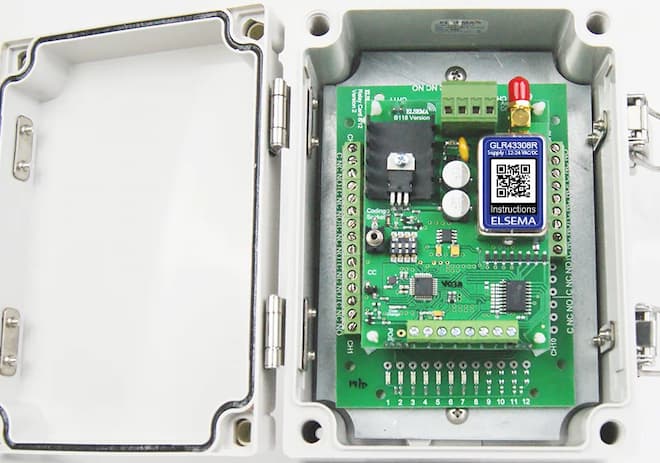
The versatility of wireless receivers depends on the number of channels they come with. Usually, this goes up to 16 channels, which means you can control 16 different devices with a properly set up Elsema audio transmitter and receiver kit. However, it’s not all about the number of channels the receiver has, as none of it matters if the number and types of outputs it has and supports don’t complement its abilities.
Power Input
A receiver’s power input, or simply put, its power supply, affects its ability to operate in different environments. A receiver with a power input of 240V AC is a mains-powered model, which is the most versatile one you can get in this case. However, there are some models that come with a more limited power input in the form of a voltage range between 7V and 36V DC or 10V to 28V AC/ DC. If you need something more specific, you can go with the latter; however, if you want to make a setup that will operate within a wider range of installations and satisfy their needs, the former is the way to go.
Output Type
Another factor that affects both the capabilities and compatibility of a receiver is the type and number of outputs it supports. Obviously, the more the merrier, but that isn’t always a good thing if the channel count isn’t there to support the outputs. However, many models, especially those from Elsema, support relay switching for higher-power loads, as well as open-collector (positive-switching) outputs, and some connect to access control systems, usually using the Wiegand protocol.
Elsema Transmitters
GLT43301
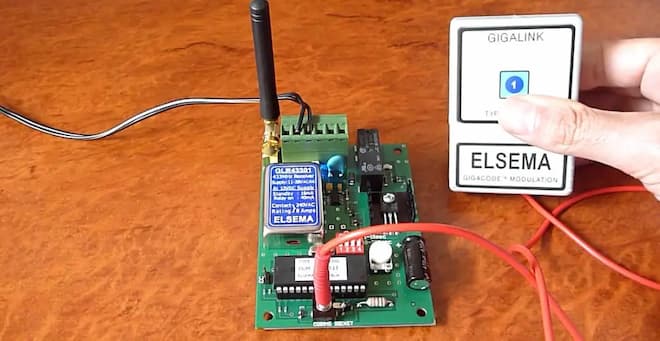
The GLT43301 wireless audio transmitter from Elsema is a 1-button remote powered by a 9V battery. It has an operating range of 500 metres. The GLT43301 remote is part of Elsema’s Gigalink series, which means it uses a programming method that can select a random code from 4 billion unique combinations. This makes it an extremely secure and capable unit that can be used across vast areas without issue or privacy concerns.
GLT43308
source: manuals.plus
Like the GLT43301, the GLT43308 operates at the same 433 MHz frequency and is capable of reaching the same 500 metre range. However, the GLT43308 wireless transmitter is an 8-button remote, meaning it can communicate with up to 8 different devices. It also uses the same encryption method as the GLT43301, but it’s a bit larger due to the fact that it needs to make room for 7 more buttons on the front. The same 9V alkaline battery powers the GLT43308, making it suitable for both industrial and commercial applications.
Accessories
Antennas
Obviously, the antenna for your transmitter and receiver kit needs to operate on the same frequency. But that’s not all, as the type of antenna you choose determines the range and performance you’ll get out of it. A miniature antenna is compact and ideal for short-range use case scenarios. Standard antennas offer a balance between performance and range as they’re often used in both residential and some industrial settings. High-gain antennas are made to extend the range of your setup and thus require ideal positioning to get the most out of them.
Programming Cables & Adapters
There is only one way to go when it comes to programming cables, as Elsema’s products work best with the GL-CAB cable. With it, you get remote pairing and the ability to configure their Gigalink receivers. This type of cable is also needed if you want to manage multiple devices at the same time. If you’re working with sensitive electronics, make sure to use surge-protected adapters to avoid issues during voltage spikes.
Mounting Brackets & Enclosures
Last but not least, you should ensure that both the wireless receivers and transmitters are well protected from physical damage and the elements. This is done by getting an enclosure that meets safety standards and is suitable for the environment you’ll use the kit in. The same goes for the brackets you pair with the enclosure, as they keep the setup secure and stable.




 Choosing the Right Elsema Components for Your Wireless Control System
by Peter Brown+ - Comments Off on Choosing the Right Elsema Components for Your Wireless Control System
Choosing the Right Elsema Components for Your Wireless Control System
by Peter Brown+ - Comments Off on Choosing the Right Elsema Components for Your Wireless Control System
 HÅG
by Peter Brown+ - Comments Off on HÅG
HÅG
by Peter Brown+ - Comments Off on HÅG
 Avenel Hats
by Eva Robinson+ - Comments Off on Avenel Hats
Avenel Hats
by Eva Robinson+ - Comments Off on Avenel Hats
 Western Global
by Peter Brown+ - Comments Off on Western Global
Western Global
by Peter Brown+ - Comments Off on Western Global
 4 Reasons Full-Face CPAP Masks Outperform Other Styles
by Eva Robinson+ - Comments Off on 4 Reasons Full-Face CPAP Masks Outperform Other Styles
4 Reasons Full-Face CPAP Masks Outperform Other Styles
by Eva Robinson+ - Comments Off on 4 Reasons Full-Face CPAP Masks Outperform Other Styles
 John Deere
by Peter Brown+ - Comments Off on John Deere
John Deere
by Peter Brown+ - Comments Off on John Deere
 Foton
by Peter Brown+ - Comments Off on Foton
Foton
by Peter Brown+ - Comments Off on Foton
 Komatsu
by Peter Brown+ - Comments Off on Komatsu
Komatsu
by Peter Brown+ - Comments Off on Komatsu
You must be logged in to post a comment Login